AI calorie tracking apps promise instant estimates from a photo. But how accurate are they really?
This guide explains how AI calorie trackers work, typical error margins, what affects accuracy, and when they’re reliable enough for real-world use.
When used correctly, most AI calorie trackers estimate calories within 5–15% of manual logging.
Accuracy depends on:
For everyday calorie tracking, this level of accuracy is typically sufficient for building consistent trends.
For precision-based goals (competition prep, clinical settings), manual weighing may still be preferred.
AI calorie trackers analyze:
Unlike traditional apps such as MyFitnessPal or Lose It!, which rely on searchable food databases, AI systems rely on visual pattern recognition.
The process typically includes:
This is fundamentally different from manual logging.
If you want a full overview of AI-based tracking:
Clear, well-lit photos improve recognition.
Best practices:
Blurry or cropped images reduce accuracy.
AI estimates volume visually.
Foods that are:
can slightly reduce precision.
Mixed dishes like:
are more complex.
However, AI models are trained specifically for mixed meal estimation — which is why many users prefer scanning over manual reconstruction.
If you're looking to scan meals directly:
Oil, butter, and dressings can be harder to detect visually.
Manual logging also struggles here unless measured precisely.
Manual logging seems more precise — but it has its own issues:
Traditional database apps like MyFitnessPal rely heavily on community entries.
AI systems estimate visually, while manual systems rely on user input.
Both have margin of error.
The difference is:
Manual logging is time-intensive.
AI tracking is frictionless.
For many users, consistency matters more than slight differences.
If you're searching for a calorie tracker without logging:
Weight change is driven by:
A 10% margin difference across days often balances out if tracking is consistent.
For example:
If your true intake is 2,500 calories and AI estimates 2,375–2,625, long-term trends remain reliable.
For most:
AI accuracy is sufficient.
For elite-level precision:
Occasional weighing can supplement scanning.
If you're tracking for weight gain specifically:
AI may be less precise for:
Understanding limitations improves expectations.
Transparency builds trust.
Barcode scanning works well for:
AI scanning works well for:
Both systems can coexist depending on context.
Yes, for most people. Consistent tracking with small margin differences still produces reliable trends.
Yes. Controlled surplus tracking typically tolerates minor estimation differences.
Both have margin of error. AI reduces manual entry mistakes; database apps rely on user-submitted entries.
Not necessarily. Many users rely solely on AI scanning. Weighing can be used occasionally for extra precision.
Yes. Clear, well-lit photos improve estimation accuracy.
If you require laboratory-level precision, manual weighing is still the gold standard.
But for real-world tracking:
AI calorie trackers are accurate enough for most people.
And because they reduce friction, they improve consistency — which ultimately drives results.
If you want to experience AI-based tracking:
→ Explore the full system here:
AI Calorie Tracker

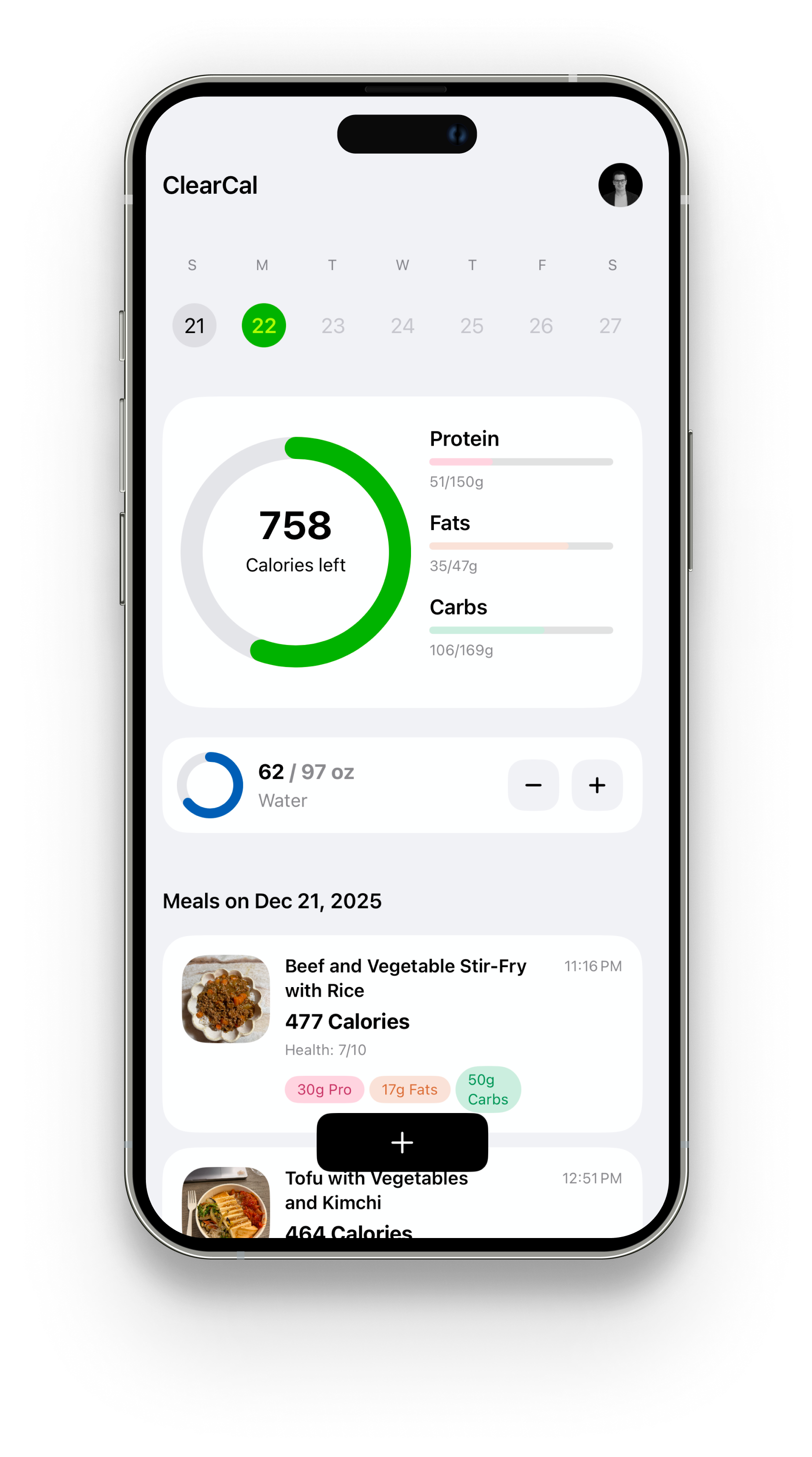

Snap a photo or describe your meal, and ClearCal analyzes each meal so you can acheive your goals without the headaches.