If you’ve ever started tracking calories — and then stopped a few weeks later, you’re not alone.
Calorie counting doesn’t fail because people are lazy.
It fails because the system is often built around friction, perfection, and burnout.
This guide explains the real psychological reasons calorie counting fails and how to fix them.
Calorie counting fails when:
When tracking becomes stressful, consistency drops.
And without consistency, results disappear.
Traditional calorie tracking apps require:
Apps like MyFitnessPal and Lose It! rely heavily on manual entry.
That system works — but it creates friction.
Friction accumulates.
What starts as motivation turns into:
“I’ll log it later.”
Later becomes never.
If you’re looking for a simpler approach:
Many people quit because they believe:
If I can’t weigh everything perfectly, I’m doing it wrong.
This leads to:
But calorie tracking isn’t about precision at every meal.
It’s about trend awareness over weeks.
If you're wondering whether perfect accuracy even matters:
Most people rely on motivation.
Motivation spikes after:
But motivation fades.
Systems sustain behavior.
If your tracking system requires 10 minutes per meal, it depends on motivation.
If it takes 10 seconds, it becomes automatic.
If you're new and overwhelmed:
Many apps use streaks and daily goals.
Miss one day, and the streak resets.
Psychologically, this creates:
All-or-nothing thinking.
One imperfect meal becomes:
“I ruined it. I’ll restart Monday.”
But long-term progress isn’t built on streaks.
It’s built on averages.
Every meal requires:
This creates decision fatigue.
When your brain is tired, the simplest option wins:
Don’t log.
Reducing cognitive load increases consistency.
This is why systems that simplify tracking tend to last longer.
If you're looking for an easier system:
Here’s what sustainable calorie tracking looks like:
Tracking should feel neutral.
Not intense.
Not obsessive.
Not exhausting.
Consistency matters more than small calorie differences.
Daily fluctuations don’t matter. Weekly averages do.
Food is data, not morality.
Systems that minimize typing and searching improve adherence.
If logging feels heavy, try simplifying:
For weight loss:
People underestimate calories and give up when results stall.
For weight gain:
People assume they’re eating enough — but aren’t.
Tracking helps both — but only if it’s sustainable.
If you're gaining weight intentionally:
Some people tie calorie counting to self-worth.
If they “mess up,” they feel failure.
But tracking is a tool.
Not an identity.
When you remove emotional weight from tracking, it becomes sustainable.
Usually because the system creates too much friction or requires too much perfection.
It can become stressful if tied to guilt or perfection. When used neutrally as data, it’s a helpful tool.
Often due to inconsistency, underestimation, or burnout.
Yes — if the system reduces friction and avoids all-or-nothing thinking.
Yes. Systems that reduce manual entry and simplify logging improve adherence.
It’s likely the system.
Make tracking:
Faster.
Simpler.
Less emotional.
Less perfect.
If you want to explore a lower-friction approach:
→ Start here:
AI Calorie Tracker

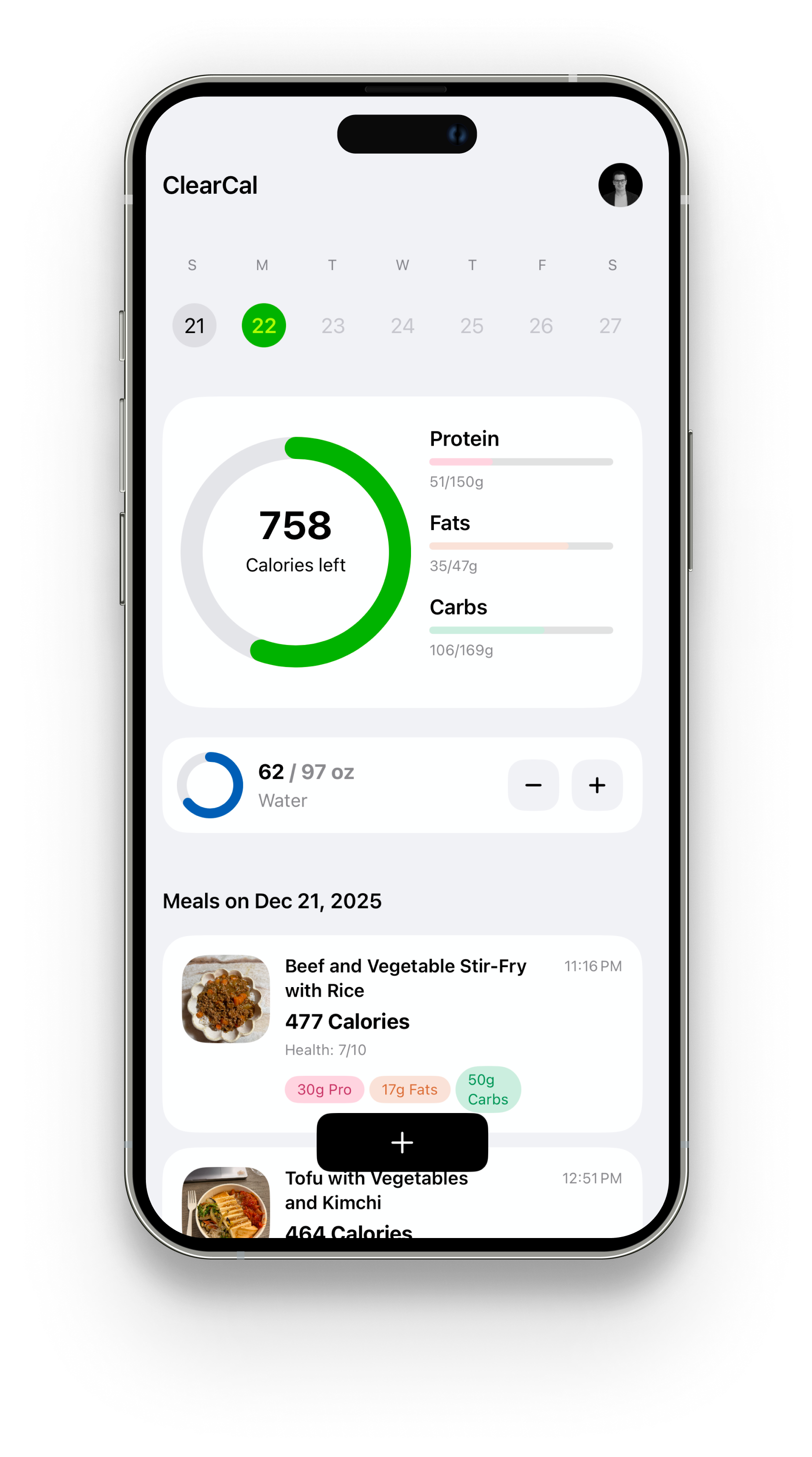

Snap a photo or describe your meal, and ClearCal analyzes each meal so you can acheive your goals without the headaches.